Freelancers and small businesses in Venezuela, Guatemala, and Paraguay hit the same wall. Clients abroad are ready to pay. The hard part is collecting that money and getting it into a local account.
PayPal and Stripe are the first two names people try. In all three countries, both come with limits worth knowing before you send your next invoice.
Where PayPal and Stripe stand in each country
The rules differ in each market, so check yours before you promise a client a payment method.
Venezuela. PayPal does not transfer balances to Venezuelan bank accounts. You can hold money in the account, but moving it home means going through a third party service. Stripe does not operate in Venezuela at all.
Guatemala. PayPal supports sending, receiving, and withdrawing, and payouts arrive in USD. What you cannot do is link a Guatemalan bank account for a direct withdrawal, so most people route the balance through another provider. Stripe does not list Guatemala among its supported countries.
Paraguay. PayPal works for sending money, but it is not a dependable way to receive and cash out to a local bank in guaraní. Stripe does not operate in Paraguay either.
People often ask about opening a US company to unlock Stripe. It is legal and it does work, but it adds registration costs, a US bank account, and yearly filings. For one solo freelancer, that is heavy overhead for a single payment button.
The payout is the real problem, not the card
Getting paid online is two separate jobs:
- Let the client pay the way they already know, usually by card or PayPal.
- Get that money out and into your hands.
Most tools solve one job and leave the other to you. That gap is why so many people in these three countries end up with a balance they can see but cannot spend.
What actually works
- Payoneer. Widely used across Latin America. You get receiving accounts in USD and EUR, and it works with Upwork and Fiverr.
- Wise. Good rates for direct clients, but availability varies by country in the region. Confirm yours is supported before you build your invoicing around it.
- USDT, a stablecoin pegged to the dollar. Fast, cheap to move, and already common across the region. Crypto adoption among freelancers runs far above the global average in Venezuela, mostly for this reason.
- A clean invoice with a payment link. Marketplaces bill on your behalf. Direct clients do not, and asking for money in a chat message slows everything down.
Set your payout method up before your first large payment, not after it lands.
Hold your earnings in dollars
Converting on every single payment is where income quietly disappears. If you can receive and hold in USD, you choose when to convert instead of accepting whatever rate applies the day the money arrives. Where the local currency moves fast, that control is worth more than a slightly lower fee.
Add up the full cost first
Before you agree to any method, count all three charges:
- The processor fee on the client side
- The currency conversion spread
- The withdrawal fee to your local bank
Only the total shows your real take home, and that is the number you should price against.
Final thought
PayPal and Stripe falling short in Venezuela, Guatemala, and Paraguay is a limitation, not a dead end. Send a clear professional invoice with a payment link, let the client pick how to pay, and take your payout in a form you can actually use.
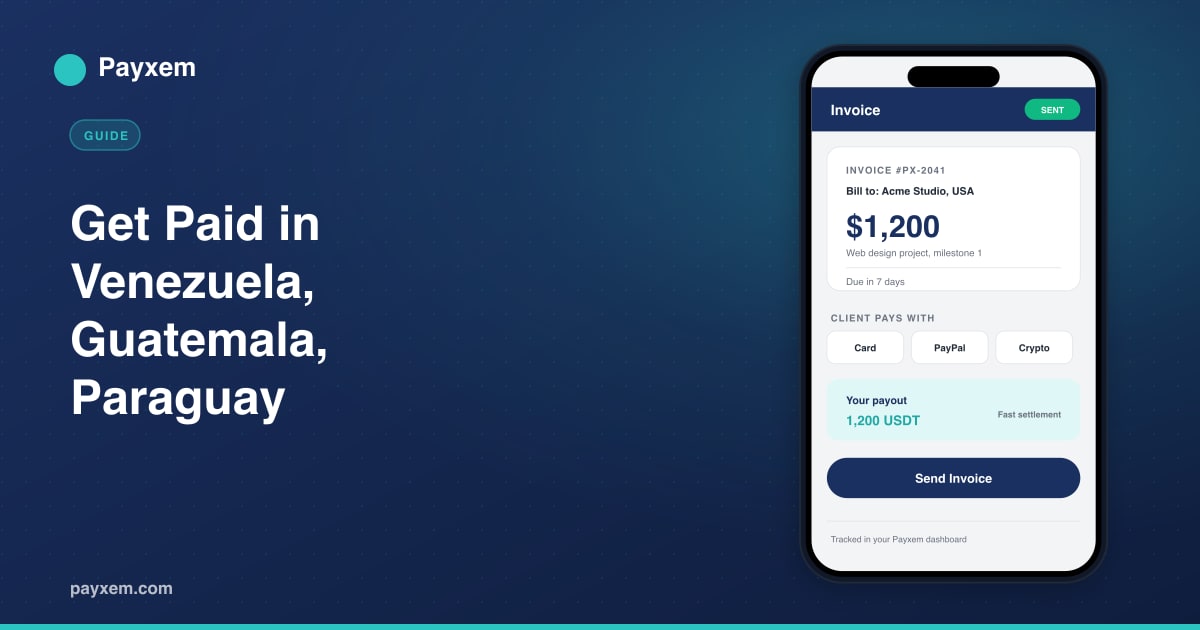
With Payxem your client pays by card, PayPal, or crypto through our checkout, so you never open a merchant account of your own. You track it all from your dashboard, and how to start walks you through the first setup.
Start now: Create a free Payxem account and send your first invoice in a few minutes.
Related reads: