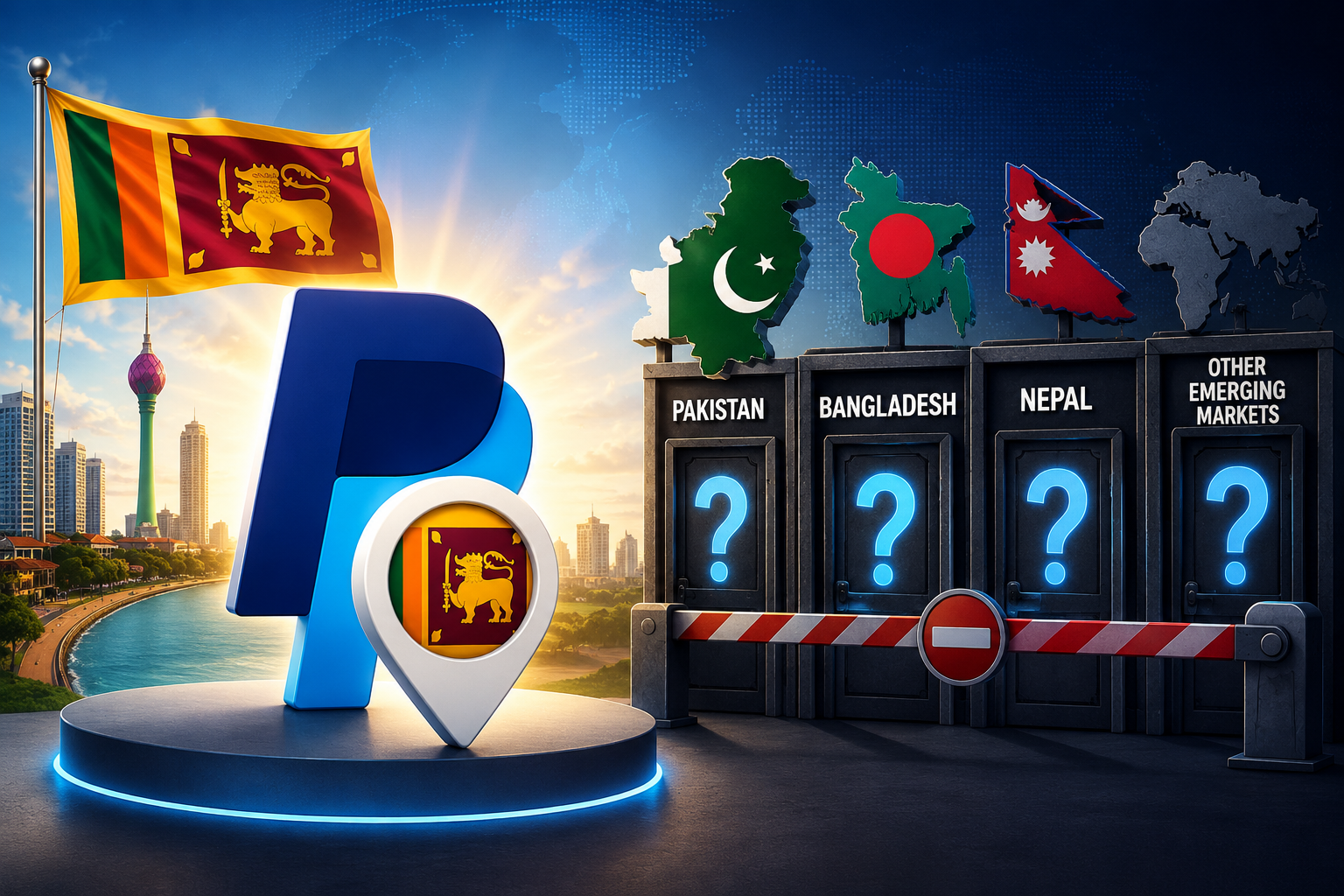
PayPal officially launched in Sri Lanka on May 15, 2026. For thousands of Sri Lankan freelancers, designers, developers, and small businesses, this is a real shift. They can finally create and link PayPal accounts, receive payments from international clients, and transfer funds to local or US dollar accounts. The rollout starts with Sampath Bank, Bank of Ceylon, and Commercial Bank of Ceylon, with more banks expected to follow.
It is good news for Sri Lanka. It is also a reminder of how far behind the rest of the region still is.
What Sri Lankan Freelancers Now Get
PayPal’s Sri Lanka launch was held at the Galle Face Hotel under the patronage of Prime Minister Harini Amarasuriya. According to local reporting, freelancers in Sri Lanka can now:
- Open a full PayPal account linked to a partner bank
- Receive payments from international clients in USD
- Transfer received funds to a local LKR account or a US dollar account
- Operate more confidently in the global digital economy
For a freelancer who has been juggling cousins in Dubai, Wise workarounds, and crypto off-ramps to get paid, this is a serious upgrade.
The Reality for Pakistan, Bangladesh, Nepal and Similar Markets
Outside Sri Lanka, the picture has not changed. PayPal and Stripe still do not function fully in most of South and Central Asia. Specifically:
- PayPal Pakistan: Receiving and withdrawing through PayPal in Pakistan remains restricted. You cannot open a full personal or business account and pull money to a Pakistani bank in the normal flow.
- PayPal Bangladesh: Limited “Xoom” inbound remittance only. Outbound and full business accounts are not available. Freelancers cannot give clients a clean “Pay me with PayPal” link tied to a Bangladeshi bank.
- PayPal Nepal: Nepalese freelancers can send money out for purchases, but receiving international client payments into a Nepali bank account through PayPal is not supported.
- Stripe Pakistan, Stripe Bangladesh, Stripe Nepal: Stripe does not operate in any of these markets. Standard “Pay with card” checkouts that work in the US, UK, or UAE simply cannot be set up by a freelancer registered in these countries.
The result is the same in every one of these markets. A freelancer can deliver world class work to a client in New York, London, or Berlin, and still spend a week figuring out how to actually receive the money.
Common Workarounds and Why They Fall Short
Most freelancers in these countries end up doing one of the following:
- Asking a relative in the UAE, UK, or US to receive PayPal and forward the money. Slow, awkward, and often comes with informal cuts.
- Opening a Payoneer account, then dealing with high withdrawal fees, currency margins, and minimum thresholds before money lands in a local bank.
- Receiving USDT into a personal crypto wallet, then converting on local P2P exchanges with manual KYC every time.
- Routing through Wise where it is partially supported, and discovering that direct card payments from clients still are not possible.
These workarounds work, but they cost time, money, and trust. Clients who are used to a one click PayPal or Stripe checkout do not enjoy being asked to send money to someone’s cousin.
How Pakistan, Bangladesh, Nepal and Other Emerging Market Freelancers Can Receive International Payments Today
This is the gap Payxem was built to close.
Payxem is a simple invoicing and payment platform for freelancers in underserved markets where global processors are limited or unavailable. Instead of waiting for PayPal or Stripe to officially arrive in your country, you sign up at app.payxem.com, share a payment link or invoice with your client, and accept payment via:
- PayPal through Payxem’s account, your client pays normally with their PayPal balance or card
- Stripe card checkout, your client pays with any credit or debit card
- Crypto (USDT BEP20) for clients who prefer on chain settlement
Funds land in your Payxem wallet after a short security hold, and you withdraw to:
- Your local bank account in the regional currency
- A USDT wallet on chain
- Wise where supported
You never ask your client to do anything unusual. They see a clean Payxem invoice or payment page, they pay with PayPal or card, and you receive a notification when the money is in.
Why This Matters for Freelancers in These Markets
A freelancer in Karachi, Dhaka, Kathmandu, Lahore, or Chittagong can finally hand a client one short link, like app.payxem.com/p/yourname, and let the client pay in whatever way is easiest for them. No more “actually, my cousin’s PayPal is fine,” no more “can you send a Wise transfer to this email.” The client experience is what global clients already expect.
Behind the scenes, Payxem handles the parts that are hard or impossible to set up directly from these countries:
- The PayPal merchant relationship
- The Stripe merchant relationship
- The crypto on chain settlement
- The compliance, KYC, and dispute handling
You focus on the work. Payxem handles the rails.
What the Sri Lanka Launch Tells the Rest of the Region
The Sri Lanka rollout proves something important. The PayPal and Stripe gap in emerging markets is real, it is widely recognized, and it eventually closes one country at a time. Sri Lanka is closing it now. Pakistan, Bangladesh, Nepal, and others are likely to follow at some point, but no one knows the timeline.
In the meantime, freelancers in these markets cannot wait. Clients hire on a Monday and expect to pay on a Friday. If your payment story is “PayPal might come to my country in a few years,” you lose the job to a freelancer in Dubai, Manila, or, now, Colombo.
Payxem is the bridge between you and that client today.
How to Start Receiving International Payments with Payxem
- Sign up at payxem.com with your email
- Complete a short KYC verification once
- Add your local bank account or USDT wallet for withdrawals
- Create your first payment link or invoice and share it with your client
- Get paid in USD via PayPal, card, or Crypto. Withdraw to your local bank or wallet
No monthly fee. No $30 a year just to receive money. Free withdrawals. Platform fee is up to 2.5% plus $0.30 per payment received, with processor fees on top depending on the method your client chose.
Sri Lankan freelancers just got their moment. If you are in Pakistan, Bangladesh, Nepal, or any other market still waiting for the big players, you do not have to wait to compete globally. Open a Payxem account, send your first invoice, and let your international clients pay you the easy way.