For generations, gold jewelry has been treated as savings. A new bangle, a chain, a set of earrings, all stored quietly in a locker and brought out for weddings and emergencies. It feels safe. It feels traditional. It feels like the right thing to do.
And for most families, it is also the most expensive way to save in gold.
This post is not about whether you should wear gold. Of course you should, if you enjoy it. This is about being honest about what counts as saving and what does not.
The illusion
When you walk out of a jewelry shop with a Rs 100,000 piece of gold, you feel like you just saved Rs 100,000. The receipt says gold. The shop says gold. Your family says gold.
But that piece is not worth Rs 100,000 in gold. A large slice of what you just paid is not gold at all. It is design, labor, taxes, and shop margin.
If you walked back in the next day and tried to sell that same piece, the same shop would offer you the weight of the gold at the day’s rate, minus a discount, minus any stones, minus a small “melting” charge. The Rs 100,000 you paid becomes a much smaller number very fast.
The gold is real. The savings is mostly not.
The real costs hiding in jewelry
There are three quiet leaks in every jewelry purchase.
Making charges. This is the fee the jeweler adds for the design and craftsmanship. It ranges from 8 percent on simple pieces to 25 percent or more on intricate work. The fancier the design, the larger the cut you lose.
GST and taxes. Layered on top of the gold value plus making charges. Once paid, it is gone. The next buyer of your piece does not pay it again to you.
Resale loss. Even after stripping the design fee and tax, jewelers will buy back the gold weight at a discount. They have to melt it, refine it, and pay their own costs. The discount lands on you.
Add the three together and a typical jewelry purchase loses 15 to 35 percent of its value the moment you leave the shop. Not over a year. Not over a decade. Immediately.
If you treated any other form of savings this way, depositing Rs 100,000 in a bank only to be told the balance was Rs 75,000 the next day, you would call it a scam.
In jewelry, we call it tradition.
A side by side example
Imagine two people, each setting aside Rs 100,000 for gold this year.
Person A buys a gold chain from a high street jeweler. After making charges and GST, the gold weight in their chain is about 7 to 8 grams. They wear it sometimes. A year later, they try to sell it. The jeweler offers them around Rs 75,000.
Person B buys gold in grams, on a digital savings platform, at the live international rate. There is a small spread of under 1 percent. Their Rs 100,000 buys close to 11 grams. A year later, gold has moved up modestly. They sell back the same 11 grams. They walk away with roughly Rs 110,000.
Same starting amount. Same year. Same gold price movement. The first person ended up with three quarters of what they put in. The second person ended up with slightly more than what they put in.
That is the cost of the format. Not the gold. Not the market. Just the format.
What actually counts as saving
A real savings habit, in any asset, looks like this.
Low friction in. You can put money in often, in small amounts, without paying a large up-front cut.
Low friction out. You can take money out at the current market value, without melting fees, design discounts, or hidden penalties.
Transparent pricing. You know the exact rate you bought at and the exact rate you sold at. No vague quotes.
No format tax. Your money is held in the thing you are saving in, not in design work you cannot resell.
Per-gram digital gold, on a platform with a small declared spread and no monthly fee, meets all four. So does silver. So do simple coin and bar purchases at known refiners, if you handle storage yourself.
Jewelry meets none of them.
You can still wear gold
The honest answer is not “stop buying jewelry.” Jewelry is part of how families celebrate, remember, and pass things down. If a gold set means something to you, that meaning is real. The mistake is calling that purchase savings.
A clean way to separate the two:
- Money you spend on jewelry is part of your lifestyle budget. The same bucket as a wedding, a holiday, a meaningful gift.
- Money you put into per-gram gold savings is part of your savings budget. Quiet, regular, built up over years.
Both can coexist. They should just not pretend to be each other.
How to start a real gold savings habit
If you have been buying jewelry every Eid and calling it savings, here is the smaller version of the switch.
One. Keep the jewelry budget you already enjoy. Do not cut it.
Two. Add a small, separate monthly amount for per-gram gold savings. Even $15 to $30 a month is enough to build a real position over a few years. There is no minimum the world will respect more than consistency.
Three. Buy at the live international per-gram price, on a platform that shows you the spread clearly and lets you sell back any time.
Four. Leave it alone. Do not check daily. Do not try to time anything. The whole point is to stop optimizing and start accumulating.
How Payxem fits in
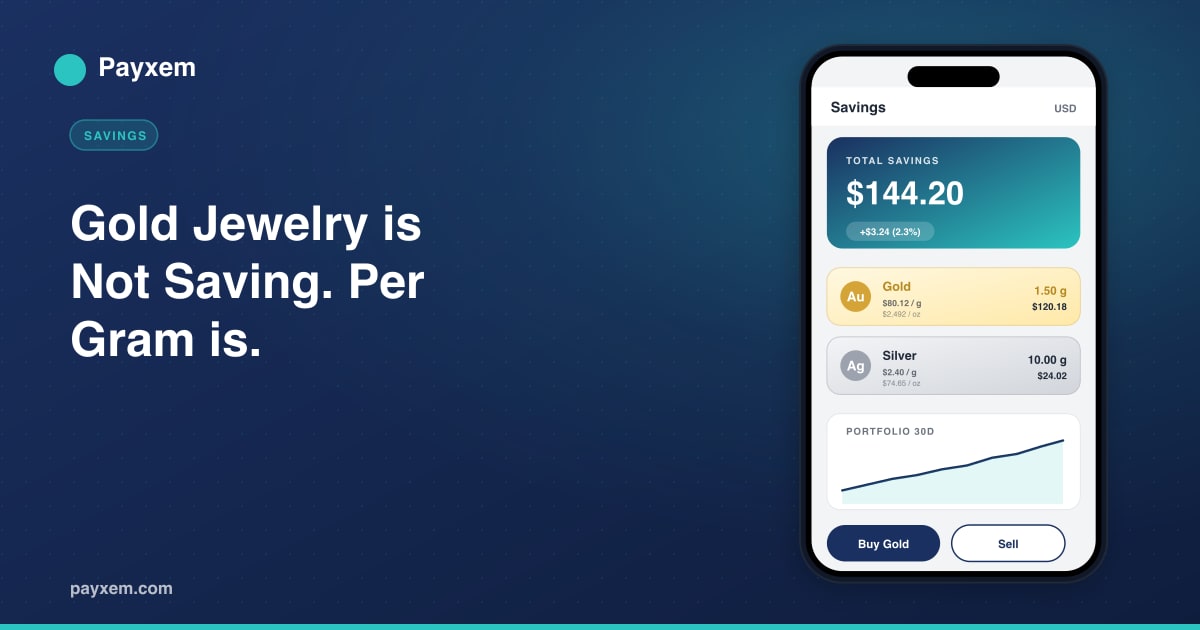
Payxem now has a Savings tab built into the same wallet you already use for client payments and withdrawals. You can buy gold or silver in grams from your USD wallet balance, at the live international per-gram price, with a small, declared spread on each buy and sell.
You can sell back to your USD balance any time. There is no holding period. No making charges. No locker. No paperwork.
For freelancers who are already getting paid through Payxem, this turns saving from a separate errand into a one-tap step inside the app you already use.
You finish a project. You get paid. You set aside a small amount in gold or silver. You move on.
Closing
The point of saving is to end the year with more buying power than you started with. Jewelry, sold honestly back into the market, almost never delivers on that. Per-gram gold savings, done quietly and consistently, often does.
If you have been calling jewelry your savings, you are not alone. Most of your friends and family probably do too. But the receipt in your hand was never the full story, and the number the jeweler offers when you go to sell is the part that has been hidden.
Wear the jewelry. Save the gold. They are different things.